
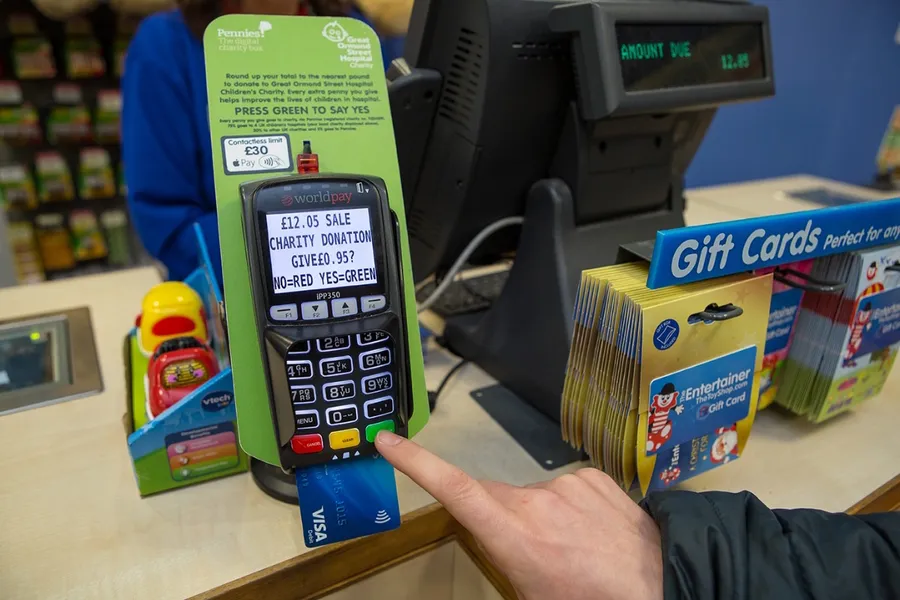
A growing number of high-street and supermarket checkouts now pause the payment and ask whether you want to add a small charity donation. The prompt is usually 10p, 20p, or a round-up to the next pound. Many shoppers find it intrusive. A common claim that follows is that the retailer is harvesting a tax write-off from your money. That claim is wrong under UK tax rules. The practice is still not as simple as “the shop is being nice.”
What the prompt actually is
Most card and contactless asks in British shops run through a specialist intermediary. The best-known is Pennies, a registered charity that plugs a donation question into the payment terminal, website or app. The customer has to press yes. If they do nothing, or press no, no extra money is taken.
The donation is added to the same card payment as the shopping. It lands in the retailer’s bank account with the rest of the sale. The retailer then settles the donated amounts with Pennies, which grants the money to the charity the shop has nominated. Pennies typically keeps around 10 per cent of each donation to fund the technology and its own charitable work. The rest goes to the nominated cause. Domino’s, which has used the scheme since 2010, publishes a similar split (92.5 per cent to regional partners, 7.5 per cent to Pennies).
Pennies says it has enabled hundreds of millions of individual micro-donations and raised more than £80 million for over 1,100 charities. The average gift across its merchants has been reported at around 23p. Individual retailers can raise large sums this way. Booths said customers gave more than £400,000 through Pennies in a single year. Greene King has reported more than £3 million for Macmillan over the life of its partnership.
The same idea appears in short supermarket campaigns that do not use Pennies. In 2025 Tesco, Sainsbury’s, Morrisons and Waitrose ran a joint “Let’s Make A Meal Of It” push for FareShare, with in-store or online round-ups. The mechanism is the same: the customer chooses, the retailer collects, the charity is paid later.
This replaced the old counter tin. Cash has fallen. A digital ask reaches people who no longer carry coins.
The tax write-off claim
The popular version of the complaint goes like this: the shop asks you for 20p, banks it as if it were their donation, and knocks it off corporation tax.
That is not how UK tax works.
A donation only reduces a company’s tax bill if it is a qualifying charitable donation of the company’s own money. Customer checkout gifts are not the company’s money. The retailer is collecting on behalf of someone else. The extra 20p should not be treated as taxable turnover, and it should not be deducted as a corporate gift either. You cannot write off income you never owned.
Gift Aid does not rescue the myth. Gift Aid lets a charity reclaim basic-rate tax on a gift from an identifiable UK taxpayer who has signed a declaration. Pennies states plainly that it keeps no donor identity, so Gift Aid cannot be claimed on these micro-donations. A supermarket campaign that also collects anonymously is in the same position.
Two related tax points are often mixed in and should be kept separate:
- If a retailer donates its own cash, or matches customer gifts from its own profits, that corporate gift can be deducted from profits for corporation tax. That is the company’s money, not yours.
- From 1 April 2026, businesses can donate eligible surplus goods to charities for free distribution or the charity’s own use without a VAT charge that previously discouraged giving stock away. That is a goods rule. It has nothing to do with a 20p tap on a card machine.
Customers almost never get a personal tax receipt for a 20p till gift either. There is no Gift Aid declaration and no record against their name. Higher-rate taxpayers cannot claim extra relief on it.
The American social-media version of this argument, which treats checkout gifts as a store “write-off,” has been fact-checked as false even under US rules. The UK position is at least as clear.
What the retailer does get
If the tax story is wrong, the suspicion that the shop benefits is not empty.
The retailer chooses the charity. The customer rarely does. That choice is a branding decision. A grocer partnering with a food-redistribution charity, or a sports retailer partnering with a youth or health charity, is aligning the till ask with the image it wants.
The retailer also gets the story. Pennies and similar schemes supply impact figures that go into annual reports, ESG pages, staff briefings and press releases. “Our customers raised £X” is useful copy. The shop did not spend £X of its own. It spent staff time, a terminal prompt, and sometimes a small administration cost.
There can be a modest operational cost. Card fees apply to the combined payment. Some firms absorb that. Pennies does not charge merchants a set-up fee, but the donated pot is not 100 per cent pass-through once Pennies has taken its share.
Older, related schemes have left a mark on trust. When the carrier-bag charge arrived, Tesco deducted £3.4 million from bag proceeds in one year for “administration” while other major chains passed the money on in full. That was not a till micro-donation, but it is the kind of episode people remember when they are asked for 20p at the pin pad.
None of this requires a secret tax trick. Reputation, staff morale, and a low-cost way to look civic-minded are enough.
Why the ask grates
The irritation is not mainly about 20p.
The moment is public, hurried, and hard to ignore. You are holding up the person behind you. A member of staff may be watching. Saying no can feel mean even when the household budget is tight. Research published in 2025 in the Journal of Retailing and Consumer Services, summarised in The Conversation, found that checkout asks often produce guilt and scepticism rather than a warm glow. People who felt pushed were less satisfied with the shop and more suspicious of the motive. Some, incorrectly, believed the company took a tax benefit from their gift.
There have also been consent failures. In 2017 Tesco ran a round-up month and shoppers told Money Saving Expert that donations appeared on receipts when they had not been asked. Tesco said no money should be taken without consent and offered refunds. The Code of Fundraising Practice and Pennies’ own rules say the same: the gift must be an active yes. A timed-out prompt that defaults to no is the intended design. A prompt that is easy to miss, or a colleague who leans on the customer, is not.
A further objection is about who should give. Large retailers make profits that dwarf a customer’s 20p. Asking the shopper while the company keeps the goodwill looks, to many people, like outsourcing generosity. That is a fair description of the economics even when the tax claim is false.
People also prefer to choose their own causes. A till prompt for a national charity the shop selected is not the same as putting a coin in the tin of a local hospice.
Virtue signalling, or something else?
It is partly virtue signalling. The retailer wants to be seen supporting a cause, at low cash cost to itself, using other people’s small change. Calling that “purpose” does not change the incentive.
It is also a practical response to the death of cash tins. Digital payments removed a habit that used to raise serious money in small amounts. A one-tap ask is an efficient replacement. Charities that would never get a corporate grant from that shop can receive a steady drip of 20p gifts. That part is real. Booths, Domino’s, Iceland, Screwfix, Co-op groups and many smaller merchants have moved seven-figure or high six-figure totals this way over time.
It can be both at once. A communications team gets a clean impact number. A food bank or children’s hospital gets a transfer. The customer funds it. The shop is not stealing a tax deduction. It is renting its queue.
Whether that bargain is acceptable is a matter of taste. Nobody has to press yes. The cleaner test for a retailer that wants the credit is whether it also gives its own money, publishes the split (including the intermediary’s cut), names the charity in plain language on the screen, and never takes a donation by default.
A note for independent shops
The same tools are available to a single high-street shop, not only to the chains. Pennies and some card providers will add a donation question to an ordinary terminal. The tax position does not change because the shop is small. Customer gifts are still not a write-off. A gift from the shop’s own till, made to a registered charity, can be.
If you run a local business and want to support a named town cause, it is usually clearer to put a collection box or QR code for that charity on the counter, or to make a direct gift and say so. Borrowing the supermarket prompt without explaining where the 10 per cent goes and which charity is paid is how the suspicion starts.
Balanced assessment
Checkout charity is not a tax scam. Under UK rules the retailer cannot treat your 20p as its deductible donation, and anonymous micro-gifts do not qualify for Gift Aid.
It is also not pure altruism. The shop chooses the cause, keeps the story, and spends little of its own cash. Some customers feel cornered. Some campaigns have taken money without a clear yes. Those complaints are about pressure and credit, not corporation tax.
The money that is properly collected does reach charities, minus the intermediary’s share. That is why the model has spread as cash has disappeared. Pressing no is allowed. Giving later, to a charity you chose, is still the more transparent option if the prompt feels like a shakedown.
Key sources
- Pennies FAQs on opt-in design, Gift Aid, and the split of each donation.
- Pennies impact reporting on totals raised and number of charities supported.
- HMRC guidance on Gift Aid and on companies making qualifying charitable donations.
- GOV.UK VAT Notice 701/1 on the April 2026 relief for donated goods.
- AP fact check of the claim that stores write off customer checkout gifts.
- The Conversation summary of checkout-charity research in the Journal of Retailing and Consumer Services (2025).
- Money Saving Expert reporting on Tesco’s 2017 round-up complaints.
- Contemporary supermarket campaign announcements for FareShare and similar till appeals.