
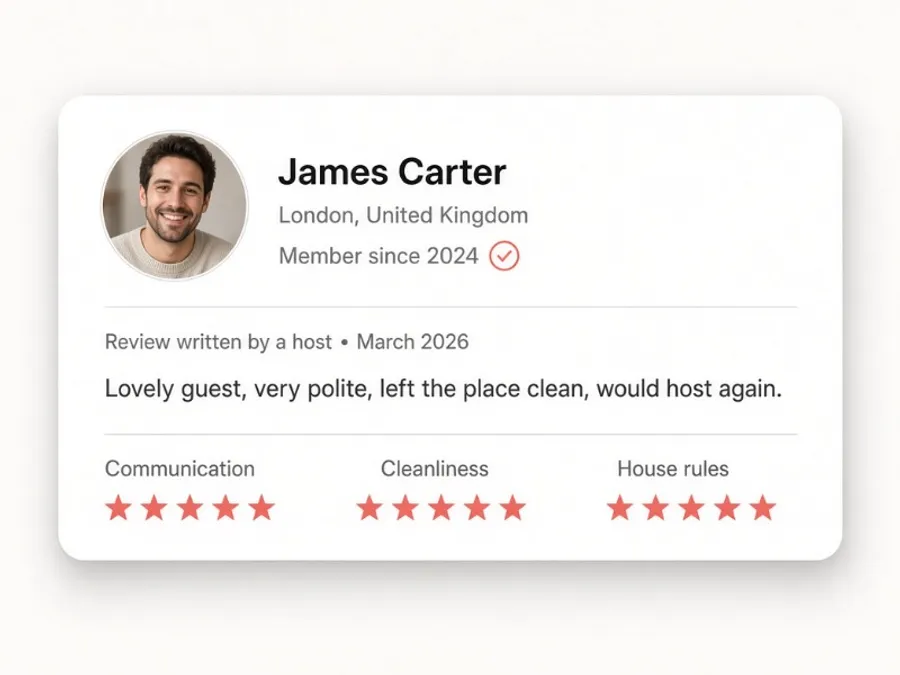
You open the request. Five stars. A few warm lines. It feels like the last host has vouched for them. That feeling is why a direct enquiry looks riskier than it is. If the platform has already checked them, why take a stranger on your own site?
It has not checked them. The five is the normal score. The system is built so that a blunt review costs the person who writes it.
The score cannot sort them
The published research is on the stars guests leave for homes. The pile on a guest profile looks the same.
Georgios Zervas, Davide Proserpio and John Byers went through millions of Airbnb listings for Marketing Letters in 2021. Nearly 95 per cent sat at 4.5 or 5. Virtually none sat under 3.5. Hotels on TripAdvisor, in the same paper, averaged about 3.8. The scrapes were from 2015 and 2018. Ask any host what a guest score looks like now and you get the same pile.
If almost every guest is a five, the five does not separate the careful ones from the ones who will leave the house a mess.
Honesty is the expensive option
Have you ever given a guest a better review than they deserved? A late checkout. A broken glass. A party that stopped short of a claim. You wrote “lovely guests” because a hard review feels like a fight, and because they are writing yours at the same time.
Airbnb did try to take the retaliation out of it. Reviews sit hidden until both sides have submitted, or until 14 days after checkout. You cannot read theirs and then punish them.
An experiment Airbnb ran on that change, written up by Andrey Fradkin, Elena Grewal and David Holtz, found the obvious result and the awkward one. When reviews were revealed together, hosts wrote more reviews with negative text, and guests were less likely to hit back with a one-star. The average star barely moved. Hiding the review made people a little braver in the words. It did not turn the number into something you can trust.
The penalty is still there. A public row with a guest is a public row with your own listing. So the written review stays kind, and the star stays high. The system does not have to ban honesty. It only has to make honesty the awkward choice. Hosts take the hint.
It arrives too late, or not at all
A first stay has no reviews, so the request looks like any other once Airbnb has ticked the identity box. A guest who was a problem last time does not have to carry that write-up. Opening a fresh account is as easy as getting a new email address. New inbox, new profile, empty history. The last host’s warning never arrives.
And a review, even a blunt one, warns the next host. It does nothing for the week you have just had. By the time the stars are public, the cleaner has been and the invoice is yours.
That is the protection you are reluctant to give up. A number almost everyone has. A paragraph the last host softened, because the system makes bluntness expensive. A blank page for anyone new. A warning that lands after the damage.
What you can check instead
The thing a direct booking can do, and the stars cannot, is look at the person before the address goes out.
If you take a booking deposit, you need a Stripe account for the card payment to land in. Stripe is the card firm. You can opt to run an identity check through that same account: the guest photographs a passport or driving licence and takes a selfie, and Stripe says verified or not. It is a switch, not a second firm. Stripe’s UK page lists that at £1.25 when a check finishes. The passport stays with Stripe. You do not keep it.
On a StayLocal booking that step can sit in the booking itself, next to the deposit, because both go through the one Stripe account. You are not emailing a link, and you are not inspecting documents. If the check does not come back verified, they do not get the address. How the guest does it is in verify every guest for less than a coffee. What the platform fee actually buys, once you take the stars out of it, is in what the commission buys.
You can keep taking bookings on the platform. The five-star reviews are not a reason to keep paying the fee on the ones you could take yourself.
Key sources
- Zervas, Proserpio and Byers, “A first look at online reputation on Airbnb, where every stay is above average”, Marketing Letters, 2021. Nearly 95 per cent of Airbnb properties at 4.5 or 5 stars. Virtually none under 3.5. TripAdvisor hotels in the same paper averaged about 3.8. Underlying scrapes from 2015 and 2018.
- Fradkin, Grewal and Holtz, “Reciprocity and Unveiling in Two-Sided Reputation Systems: Evidence from an Experiment on Airbnb”, Marketing Science, 2021. Simultaneous reveal cut retaliation and raised the share of host reviews with negative text. The average star barely moved.
- Airbnb Help Centre, Reviews for homes. Reviews post after both sides submit, or after 14 days from checkout, whichever is first.
- Stripe Identity, UK page, stripe.com/gb/identity. Document and selfie £1.25 a completed verification. Stripe stores the verification data so it need not touch the business’s systems. Checked October 2026.
- StayLocal, guest verification, staylocal.uk/guest-verification. StayLocal, what the commission buys, staylocal.uk/what-commission-buys.